

The impact of river contamination
Did you know that rivers can be full of invisible dangers?
River contamination is a global problem that often goes unnoticed. In Brazil, many rivers suffer from untreated sewage, pesticides, and pharmaceutical residues. Around the world, the situation is similar: pollution from different industries, plastics, and chemicals is threatening water quality.
Medicines, pesticides, and many other contaminants have already been detected in rivers across the globe. Even in very small amounts, these contaminants can greatly impact water quality and the environment as a whole.
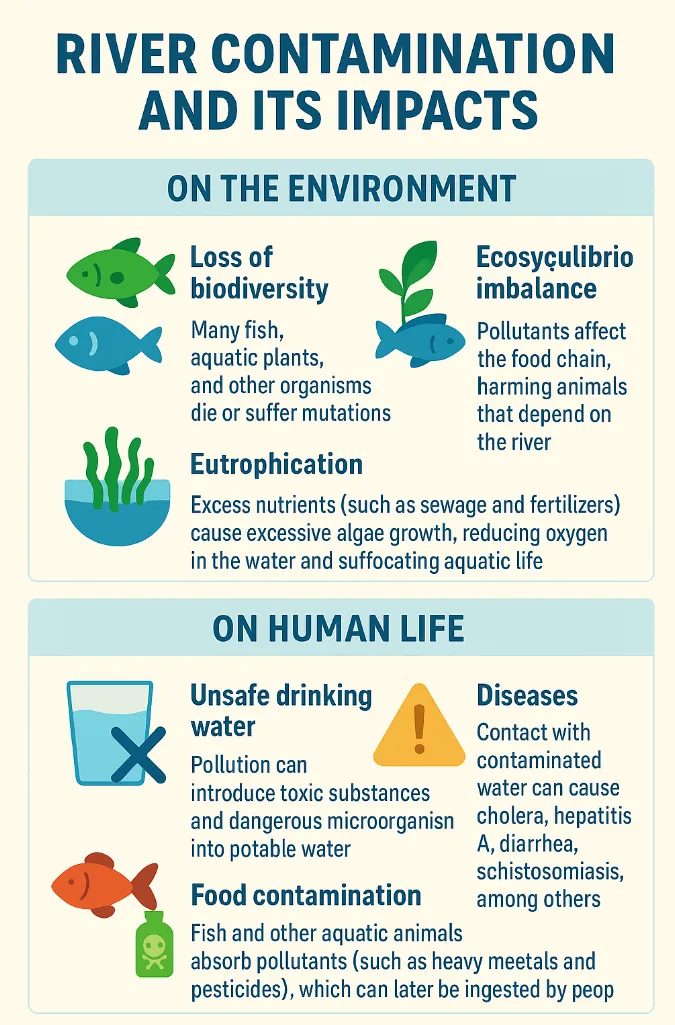
Figure 1. River contamination and its impact on humans and nature.
River pollution does not remain “trapped” in the water—it comes back to us in the form of health risks, food loss, and damage to nature.
Remember: water is essential for our existence, and its contamination can become a major risk to human health! Taking care of rivers is taking care of our lives!
What can you do?
In this sense, even small everyday actions make a big difference—each of us can be responsible for change:
In daily life:
- 🚯 Do not throw trash on the streets, it can be carried by rain into rivers.
- ♻️ Separate and recycle waste—plastic, glass, and metals take centuries to decompose.
- 🚽 Properly dispose of cooking oil, medicines, and chemicals—never down the drain or toilet.
- 🧴 Use fewer cleaning products and cosmetics with harsh chemicals, choose biodegradable versions instead.
- 🌱 Give preference to consuming foods produced without the use of pesticides.
In consumption:
- 💡 Save water, less sewage ends up in rivers.
- 🍃 Support companies that respect the environment.
- 🛍️ Reduce the use of single-use plastics.
Collectively:
- 🌳 Join river clean-up efforts or organize one in your community!
- ✊ Join collective campaigns that fight for the ban on pesticides.
- 📢 Demand proper sanitation and wastewater treatment from authorities.
- 👩🏫 Share information—the more people know, the greater the positive impact.
You may not be able to change the world alone, but you can start with your community!
Spread good actions, the results will be surprising, believe it!
References
-
D. S. de L. Moraes and B. Q. Jordão, “Degradação de recursos hídricos e seus efeitos sobre a saúde humana,” Rev. Saude Publica, vol. 36, no. 3, pp. 370–374, Jun. 2002, doi: 10.1590/S0034-89102002000300018.
-
R. Wielens Becker, L. Alves Jachstet, A. Dallegrave, A. Ruiz-Padillo, R. Zanella, and C. Sirtori, “Multi-criteria decision-making techniques associated with (Q)SAR risk assessment for ranking surface water microcontaminants identified using LC-QTOF MS,” Sci. Total Environ., vol. 797, p. 149002, Nov. 2021, doi: 10.1016/j.scitotenv.2021.149002.
Acknowledgments
Dr. Raquel Wielens Becker thanks CNPq for the PDJ fellowship (Process: 171802/2023-3).